

The digital landscape of 2025 is undergoing a profound transformation, spearheaded by the remarkable capabilities of the AI generator. No longer confined to the realm of science fiction, an AI generator is now a potent tool, fundamentally reshaping how we create, innovate, and interact with information. From crafting compelling marketing copy to designing intricate visual art and even generating functional code, these intelligent systems are democratizing creation, empowering individuals and organizations to achieve previously unimaginable feats. This comprehensive guide will explore the multifaceted world of the AI generator, dissecting its technology, applications, ethical considerations, and its boundless potential for the future. Prepare to journey into a world where creativity knows no bounds and efficiency reaches new heights, all powered by the artificial intelligence generator.
Key Takeaways
- AI Generators are Transformative: These tools are revolutionizing content creation across text, image, video, and code, offering unprecedented speed and scale.
- Diverse Applications: From marketing and education to art and software development, the utility of an AI generator is incredibly broad and continues to expand.
- Ethical Considerations are Crucial: Addressing biases, ensuring responsible use, and navigating copyright are paramount as AI generator technology advances.
- User Customization is Key: Effective prompting and understanding model capabilities are essential for maximizing the output quality of any AI generator.
- The Future is Collaborative: AI generators are increasingly becoming powerful co-pilots, enhancing human creativity rather than replacing it, leading to a new era of human-AI collaboration.
What is an AI Generator? Unpacking the Core Technology
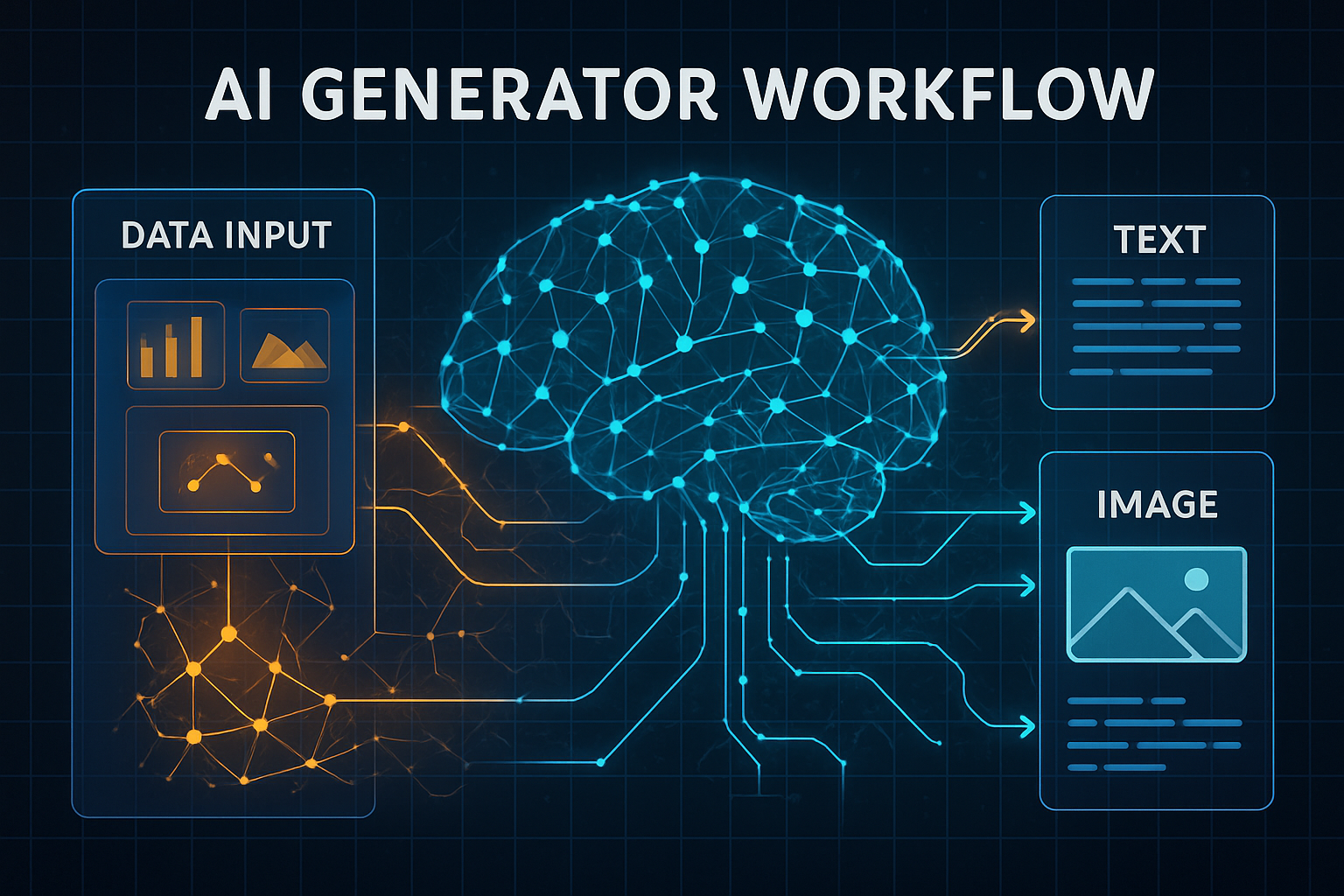
An AI generator, at its heart, is a sophisticated software system designed to produce new content autonomously, based on patterns and knowledge learned from vast datasets. These systems leverage various forms of artificial intelligence, most notably machine learning and deep learning, to understand and replicate human-like creativity. The process typically involves training complex neural networks on enormous amounts of data – be it text, images, audio, or video – allowing the AI generator to identify intricate relationships, styles, and structures.
The Mechanism Behind the Magic
The “magic” of an AI generator stems primarily from advanced neural network architectures. Two of the most prominent types include:
- Generative Adversarial Networks (GANs): GANs consist of two competing neural networks: a generator that creates new data (e.g., an image) and a discriminator that tries to distinguish between real data and the generator’s fakes. Through this adversarial process, the generator continually improves its ability to create highly realistic outputs.
- Transformers (and Large Language Models – LLMs): Transformers are particularly adept at processing sequential data like text. They utilize attention mechanisms to weigh the importance of different words in a sequence, allowing them to understand context and generate coherent, contextually relevant text. LLMs like GPT-4 are prime examples, trained on billions of text parameters to generate human-quality prose.
- Diffusion Models: These models work by learning to reverse a process of gradually adding noise to data. They can then generate new, clean data (like images) by starting from random noise and incrementally refining it. This technique has gained significant traction for high-quality image generation.
Pull Quote: “The AI generator isn’t just a tool; it’s a paradigm shift in how we approach creation, offering a glimpse into a future where ideas can manifest at the speed of thought.”
When a user provides a “prompt” to an AI generator, this input acts as a directive, guiding the AI on what to produce. The AI then processes this prompt, draws upon its learned knowledge, and synthesizes new content that aligns with the request. The quality and specificity of the prompt often directly correlate with the relevance and excellence of the AI generator’s output.
Evolution of AI Generation
The concept of machines generating content isn’t new, but the sophistication and accessibility of an AI generator have exploded in recent years. Early systems could generate simple text or basic images. Fast forward to 2025, and we have AI generators capable of:
- Hyper-realistic imagery: indistinguishable from photographs.
- Fluent, contextual text: from articles and marketing copy to creative writing and code.
- Dynamic videos: with customizable scenes and characters.
- Unique audio compositions: including music and voiceovers.
This rapid evolution is driven by advancements in computational power, access to massive datasets, and innovative algorithmic research.
Diverse Applications of an AI Generator in 2025
The utility of an AI generator spans virtually every industry and creative discipline. Its ability to produce content at scale, often with remarkable quality, makes it an indispensable tool for professionals and hobbyists alike.
Content Creation & Marketing
For marketers and content creators, an AI generator is a game-changer.
Related Posts:
- Blog Posts & Articles: Generate drafts for articles, blog posts, and website content in minutes, allowing writers to focus on editing and refining.
- Social Media Content: Quickly create engaging captions, hashtags, and even visual assets for various social media platforms.
- Ad Copy: Develop compelling headlines, ad descriptions, and calls-to-action tailored to specific audiences.
- Email Campaigns: Draft personalized email newsletters and promotional content, enhancing engagement and open rates.
- Product Descriptions: Generate detailed and attractive descriptions for e-commerce products, saving immense time.
Chek also: free AI generator options without restrictions, a helpful resource.
Art & Design
Artists and designers are embracing the AI generator as a powerful creative partner.
- Concept Art: Rapidly generate multiple concept art pieces for games, films, or animations, accelerating the ideation phase.
- Illustrations: Create unique digital illustrations, patterns, and textures for various projects.
- Logo Design: Experiment with countless logo variations and styles based on textual prompts.
- Image Editing & Manipulation: Beyond generation, AI can enhance, upscale, or modify existing images with impressive precision. 🎨
Software Development & Coding
Developers are leveraging AI generators to streamline their workflow.
- Code Generation: Automatically generate code snippets, functions, or even entire scripts in various programming languages, reducing manual coding effort.
- Debugging: AI can assist in identifying and suggesting fixes for bugs in code.
- Documentation: Generate comprehensive documentation for software projects, making it easier for teams to understand and maintain codebases.
- UI/UX Prototyping: Quickly generate design mockups and UI components based on design specifications.
Education & Research
In academic settings, an AI generator offers new avenues for learning and discovery.
- Learning Aids: Generate summaries of complex texts, create quizzes, or explain difficult concepts in simpler terms.
- Research Assistance: Help in brainstorming research questions, drafting literature reviews, or even generating synthetic data for analysis.
- Personalized Learning: Create customized learning paths and content tailored to individual student needs and learning styles.
Entertainment & Media
The entertainment industry is exploring the creative potential of AI generators.
- Scriptwriting: Generate dialogue, scene descriptions, or plot outlines for films, television shows, and games.
- Music Composition: Create original musical pieces, background scores, or sound effects.
- Virtual World Creation: Design entire virtual environments, characters, and assets for gaming and metaverse applications.
Navigating the Landscape of AI Generator Tools in 2025
The market for AI generator tools is vibrant and constantly expanding. Users now have a wide array of options, each specializing in different content types and offering unique features.
Text-Based AI Generators
These are perhaps the most widely adopted an AI generator category, primarily focusing on language tasks.
- OpenAI’s ChatGPT (and GPT-series models): Renowned for its conversational abilities and versatile text generation, from creative writing to technical explanations.
- Google’s Gemini: A powerful multi-modal AI designed to understand and operate across different types of information, including text.
- Anthropic’s Claude: Focused on safety and helpfulness, excelling in long-form content generation and complex reasoning.
- Jasper AI: A popular choice for marketers, offering templates for various content types and integrations with other tools.
- Copy.ai: Specializes in marketing copy, social media content, and sales outreach.
Image-Based AI Generators
These tools translate text prompts into stunning visual art.
- Midjourney: Known for its artistic and often surreal image generation, pushing creative boundaries.
- Stable Diffusion: An open-source model offering extensive customization and local deployment options, favored by developers and artists seeking control.
- DALL-E 3 (integrated with ChatGPT Plus): Excels at understanding complex prompts and generating images with intricate details and styles.
- Adobe Firefly: Integrated into Adobe’s creative suite, focusing on safe-for-commercial-use image generation and editing functionalities.
Video and Audio AI Generators
Emerging as powerful tools for dynamic content.
- Synthesys AI Studio: Offers AI voiceovers, video generation from text, and avatar creation.
- RunwayML: Provides a suite of AI-powered video editing and generation tools, including text-to-video capabilities.
- ElevenLabs: Specializes in hyper-realistic voice generation and cloning, ideal for narration and audio content.
- AIVA (Artificial Intelligence Virtual Artist): Composes original music in various genres.
Code-Based AI Generators
Assisting developers with their daily tasks.
- GitHub Copilot: Integrates directly into IDEs to suggest code snippets and complete functions.
- Code Llama (Meta): An open-source AI model specifically for coding tasks, built on Llama 2.
Tip: When choosing an AI generator, consider your primary need (text, image, code), budget (free vs. premium), and desired level of control and customization. Many platforms offer free trials.
The Art of Prompt Engineering for an AI Generator
The effectiveness of an AI generator largely depends on the quality of the “prompt” – the instructions given to the AI. Crafting clear, detailed, and precise prompts is a skill known as prompt engineering, and it’s becoming increasingly vital.
Key Principles of Effective Prompting
- Be Specific: Vague prompts lead to vague results. Instead of “Write about dogs,” try “Write a 500-word informative article about the history of domesticated dogs, focusing on their role as companions and workers, in a friendly and engaging tone.”
- Provide Context: Give the AI generator enough background information. Who is the target audience? What is the purpose of the content?
- Define Output Format: Specify the desired format. “Generate a list,” “Write a paragraph,” “Create an image in the style of Van Gogh,” “Output as JSON.”
- Set Constraints: Include limitations or requirements. “Keep it under 200 words,” “Avoid jargon,” “Use only warm colors.”
- Give Examples (Few-Shot Prompting): If possible, provide one or two examples of the desired output. This helps the AI understand the pattern you’re looking for.
- Iterate and Refine: The first prompt might not yield perfect results. Experiment, add details, remove ambiguities, and refine your instructions based on the AI generator’s output.
Example Prompt for an Image AI Generator: “Generate a highly detailed, photorealistic image of a futuristic cityscape at dusk, with flying cars, towering illuminated skyscrapers, and a holographic advertisement for a new AI generator product. The style should be cyberpunk, vibrant, and moody, with reflections on wet streets. Aspect ratio 16:9.”
Understanding how different AI generator models interpret prompts can also significantly impact results. Some models respond better to shorter, more direct instructions, while others thrive on elaborate narratives. Mastering prompt engineering is a critical skill for anyone looking to harness the full power of an AI generator in 2025.
Ethical Considerations and Challenges of an AI Generator
As AI generator technology advances, so do the discussions around its ethical implications and potential challenges. Responsible development and use are paramount.
Bias in AI-Generated Content
AI generators learn from the data they are trained on. If this data contains biases (e.g., gender stereotypes, racial prejudices, or underrepresentation of certain groups), the AI can perpetuate and even amplify these biases in its outputs. Addressing this requires careful curation of training data and ongoing efforts to detect and mitigate bias in AI generator models.
Copyright and Ownership
Who owns the content generated by an AI generator? This is a complex legal question that intellectual property lawyers are actively debating. Is it the user who provided the prompt, the company that developed the AI, or is it uncopyrightable? The answer often varies by jurisdiction and the specific terms of service of the AI generator. This uncertainty can create challenges for commercial use of AI-generated content.
Misinformation and Deepfakes
The ability of an AI generator to create highly realistic text, images, and videos poses a significant risk for the spread of misinformation and the creation of “deepfakes.” Malicious actors can use these tools to generate convincing fake news, fabricate evidence, or impersonate individuals, with potentially severe societal consequences. Developing robust AI detection tools is a critical countermeasure. For those interested in the free status of AI detection tools like Google Auto Checker click here .
Job Displacement
The rise of the AI generator has sparked concerns about job displacement in creative and knowledge-based industries. While AI is likely to automate certain repetitive tasks, it’s also creating new roles and transforming existing ones, emphasizing human oversight, critical thinking, and advanced prompting skills. The focus shifts from pure content creation to content management, refinement, and strategic application.
Transparency and Accountability
It’s often difficult to understand how an AI generator arrives at a particular output (“the black box problem”). This lack of transparency can hinder accountability, especially when AI makes decisions with significant impact. Future AI generator development needs to prioritize explainability and auditability.
The Future of the AI Generator: Beyond 2025
The trajectory of the AI generator is one of rapid and continuous advancement. Looking beyond 2025, we can anticipate several transformative trends.
Hyper-Personalization
Future AI generators will likely offer unprecedented levels of personalization. Imagine an AI generator that can create an entire marketing campaign, including visuals, copy, and video, perfectly tailored to an individual consumer’s preferences, past behaviors, and real-time context. This level of customization will redefine user experiences across all digital touchpoints.
Multi-Modal and Cross-Modal Generation
While current AI generators excel in specific modalities (text, image), the next generation will seamlessly generate content across multiple modalities simultaneously. A single prompt could generate a video with accompanying script, custom music, and voiceovers. Cross-modal generation will allow for translating content from one format to another with greater fidelity, e.g., describing an image to generate a detailed 3D model.
Enhanced Human-AI Collaboration
The relationship between humans and the AI generator will evolve into a deeper, more symbiotic collaboration. AI will act less as a standalone creator and more as an intelligent co-pilot, anticipating needs, offering creative suggestions, and automating tedious tasks, freeing up human creators to focus on higher-level strategy, emotion, and truly unique insights. This synergy will lead to exponential increases in creative output and quality.
Real-time & Adaptive Generation
AI generators will become increasingly capable of real-time content generation and adaptation. Imagine live streaming events where AI dynamically generates visuals, commentary, or even interactive narratives based on audience engagement and real-time data. This could revolutionize interactive entertainment, education, and dynamic content delivery.
Ethical AI and Regulation
As AI generator technology becomes more pervasive, there will be an increased focus on developing “ethical AI” frameworks and potentially stricter regulations to address concerns around bias, intellectual property, and misinformation. We can expect more robust AI detection tools and watermarking technologies to become standard.
Democratization of Advanced Creation
The power of sophisticated AI generators will become even more accessible to the general public. Complex creative tasks that once required specialized skills and expensive software will be within reach for anyone with an idea and a prompt, further leveling the playing field for content creation and innovation. This will empower a new generation of citizen creators and entrepreneurs.
Customizing Your AI Generator Experience
While many AI generator tools are “out-of-the-box,” there are increasing opportunities to customize them for specific needs, leading to even more precise and valuable outputs.
Fine-Tuning Models
For organizations with specific datasets or unique brand voices, fine-tuning an existing AI generator model on their proprietary data can yield highly specialized results. This involves training the base model further on a smaller, curated dataset, allowing it to adapt to specific styles, terminology, or content types. This is particularly useful for enterprise applications where brand consistency and accuracy are critical.
Leveraging APIs and Integrations
Many advanced AI generator platforms offer Application Programming Interfaces (APIs), allowing developers to integrate AI capabilities directly into their own applications, websites, or workflows. This enables custom solutions, automated content pipelines, and the creation of entirely new AI-powered products. Seamless integrations with popular creative suites, CMS platforms, and marketing tools are becoming standard, creating powerful ecosystems.
Utilizing Plug-ins and Extensions
The ecosystem around AI generators is growing, with a proliferation of plug-ins and extensions that enhance their capabilities. These can include:
- Prompt Managers: Tools to help organize, save, and refine prompts.
- Style Transfer Filters: To apply specific artistic styles to generated images.
- Content Rewriters/Optimizers: To refine AI-generated text for SEO or readability.
- AI Detection Integrators: To check content for AI generation.
Community and Custom Models
For open-source AI generators like Stable Diffusion, a vibrant community contributes custom models, checkpoints, and extensions. These often cater to niche styles, specific character types, or specialized workflows, offering a vast array of options for users willing to delve deeper into customization. Participating in these communities can unlock advanced functionalities and unique creative possibilities.
By actively engaging with these customization options, users can transform a generic AI generator into a highly specialized tool perfectly aligned with their creative and business objectives, further solidifying its role as an indispensable asset in 2025 and beyond.
Conclusion: The AI Generator – An Indispensable Partner for 2025 and Beyond
The rise of the AI generator marks a pivotal moment in technological history, fundamentally altering the landscape of creation, innovation, and productivity. In 2025, these sophisticated tools are no longer mere novelties but essential components across virtually every sector, empowering individuals and organizations to generate diverse content types with unparalleled speed and scale. From revolutionizing marketing campaigns and artistic endeavors to assisting in complex software development and enriching educational experiences, the impact of an AI generator is profound and far-reaching.
While the challenges of ethical use, bias mitigation, and intellectual property remain critical areas for ongoing discussion and development, the immense benefits offered by an AI generator are undeniable. As we look to the future, the evolution will see even more personalized, multi-modal, and seamlessly integrated AI systems, fostering a new era of human-AI collaboration that promises to unlock previously unimaginable creative potential. Mastering the art of prompt engineering, understanding the nuances of different AI generator tools, and actively engaging with ethical considerations are key to harnessing this transformative technology responsibly and effectively. The AI generator is not just a tool; it is a catalyst for a future where creativity and efficiency converge, paving the way for innovations that will shape our world for decades to come.
Actionable Next Steps:
- Experiment Actively: Choose a reputable AI generator (text or image) and dedicate time to experimenting with different prompts.
- Learn Prompt Engineering: Invest time in understanding how to craft effective prompts. Online tutorials and community forums are excellent resources.
- Stay Informed on Ethics: Keep abreast of discussions and developments regarding AI ethics, bias, and copyright. This awareness is crucial for responsible use.
- Explore Different Tools: Don’t limit yourself to one AI generator. Each has its strengths and weaknesses; exploring various options can broaden your capabilities.
- Integrate Smartly: Consider how an AI generator can be integrated into your existing workflows to enhance, not replace, human creativity and expertise.
Frequently Asked Questions About AI Generators
What exactly is an AI generator?
What types of content can an AI generator create?
Is content generated by an AI generator truly original?
How do I get the best results from an AI generator?
What are the main ethical concerns with AI generators in 2025?
How To Use an AI Generator Effectively
Step-by-Step Guide to Maximizing Your AI Generator Output
Define Your Goal Clearly: Before interacting with any AI generator, precisely articulate what you want to achieve. Are you writing a blog post, designing a logo, or generating code? Knowing your objective helps in crafting a focused prompt.
Craft a Detailed Prompt: This is the most crucial step. Provide as much specific information as possible. Include the desired topic, tone, style, target audience, format (e.g., “500-word article,” “photorealistic image,” “Python function”), and any specific keywords or elements to include or avoid. The more descriptive, the better.
Generate and Review the Output: Submit your prompt and wait for the AI generator to produce content. Carefully review the output for accuracy, relevance, coherence, and any biases. Look for areas that can be improved or clarified.
Iterate and Refine Your Prompt: If the initial output isn’t perfect, don’t stop there. Analyze what was missing or incorrect and modify your prompt accordingly. Add more details, clarify ambiguities, or try different phrasing. This iterative process is key to achieving optimal results.
Edit and Humanize: AI-generated content often serves as an excellent draft or starting point. Always perform a human edit to ensure the content aligns with your brand voice, is factually correct, and possesses a unique human touch. This step is vital for quality control and ethical responsibility.